


Integrated Disease Surveillance & Response Report
Download the Reports
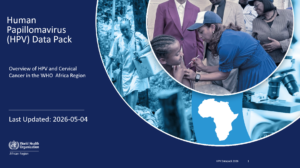
Human Papillomavirus (HPV) – Data Pack 2026
The WHO African Region HPV Data Pack 2026, providing a consolidated overview of cervical cancer burden and HPV vaccination coverage across the 47 Member States of the Region.
Context & Burden Cervical cancer is the 2nd most common cancer in women across the WHO African Region, with incidence rates nearly twice the global average and unacceptably high mortality due to limited access to screening and treatment. Over 95% of cases are caused by persistent HPV infection, making vaccination the cornerstone of primary prevention.
Progress So Far
- 36 of 47 Member States have introduced HPV vaccination over the past 14 years
- Momentum accelerated after WHO’s 2018 call for action
- 11 more countries plan to introduce by 2029
- Significant coverage and equity gaps still persist
Three Priority Actions
- Strengthen data & monitoring — build country capacity, improve data completeness and timeliness, and integrate HPV indicators into existing immunization performance frameworks
- Improve programme planning & delivery — through microplanning, validation of administrative coverage data, and evaluation of adolescent vaccination strategies
- Expand screening & treatment access — ensure a continuum of care from prevention to early detection and management
Elimination Goal (90-70-90 Targets)
- 90% of girls vaccinated by age 15
- 70% of women screened with a high-performance test by ages 35 & 45
- 90% of women with pre-cancer or cancer receiving appropriate treatment
With WHO’s endorsement of the single-dose HPV vaccination schedule and sustained momentum toward the 90-70-90 elimination targets, the opportunity to eliminate cervical cancer in the WHO African Region is within reach. Sustained commitment and coordinated action across all stakeholders will be essential.
We extend our sincere appreciation to all Member States, partners, and donors for their continued collaboration and commitment to this shared vision.
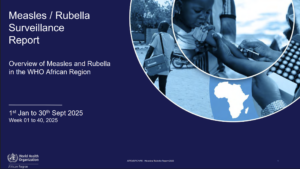
Measles / Rubella Surveillance Report Jan 2025 – Sept 2025
Measles surveillance data for the period January–September 2025 for the WHO African Region. This summary is generated using case-based and laboratory surveillance data regularly shared by Member States with WHO.
Key highlights include:
- A total of 81,315 suspected measles cases were reported, of which 34,222 (42.1%) were confirmed.
- The regional incidence of confirmed measles was 26.9 per million population.
- Children under 5 years of age accounted for approximately 63% of measles cases, while 23% were among children aged 5–9 years.
- The Western African subregion accounted for 47% of all confirmed measles cases.
- The majority of confirmed measles cases (77%) were reported from eight countries: Angola, Nigeria, Ethiopia, Democratic Republic of the Congo, Niger, Cameroon, Uganda, and Togo.
- During this period, 2,349 laboratory-confirmed rubella cases were reported, corresponding to an incidence of 1.9 per million population.
- Four island nations—Cape Verde, Mauritius, Sao Tome and Principe, and Seychelles—did not report any suspected measles or rubella cases during this time.
- In the first nine months of 2025, confirmed measles incidence reached the level of “large and disruptive measles outbreaks” (>20 per million population) in Benin, Burkina Faso, Guinea, Niger, Nigeria, Togo, Angola, Burundi, Cameroon, Central African Republic, Chad, Congo, Democratic Republic of the Congo, Ethiopia, Malawi, and Namibia. In 2025, nationwide measles or measles–rubella vaccination campaigns are planned for the fourth quarter in Chad, Congo, Central African Republic, Democratic Republic of the Congo, Nigeria, and Togo, while Ethiopia, Guinea, and Niger implemented Supplementary Immunization Activities earlier in the year.
- A total of 38,303 blood specimens were received at national measles serological laboratories during the first three quarters of 2025. Low rates of blood specimen collection were documented in Angola (31%), Madagascar (53%), South Sudan (51%), and Nigeria (51%).
- Eritrea has not shared an updated case-based database, while Rwanda, South Africa, and South Sudan did not share complete laboratory databases during this period. In addition, discrepancies between laboratory and case-based surveillance databases were observed in some countries, highlighting the need for regular data harmonization. The laboratory database from Ethiopia does not include information on specimen receipt dates, limiting the calculation of certain performance indicators.